Matt Stuart and his way of thinking about the art of street photography is what makes me believe that the opportunity to alter to perspective is everywhere and this quote demonstrates this
"I don’t go places to get excited, I stay here to get excited. You speak to most photographers and they go to Afghanistan or to China or to the Himalayas to get excited. I don’t really like the idea of going to India for three weeks and taking tourist pictures and bringing them back and going “oooh isn’t this deep and meaningful” because it’s not. It’s your holiday."
Travelling far away to get photographs that are not easily accessible does give the photographer an edge over the rest because people want to see things that they have never seen before, things that create an uncertainty within them. It becomes fresh because they cannot primarily relate to what they see and so it becomes more interesting, but why travel far away to document poverty when there is poverty on your own streets that is ignored everyday. For my final year project I am staying close to home not because I cant be bothered to travel or put my safety on the line but because there are still points to be made right here and wether or not communicating these through photojournalism is the right thing to do, At least it brings light to what needs to be seen.
"I don’t like the sort of “derisive moment.” I like humour"
Photographs record life no matter where they are pointed but to limit yourself to one aspect of photography with the aim of purely creating humour amongst your audience I think is selfish especially when you have a talent to construct aesthetics that really translate to an audience. Street photography to me is not a case of shall I use my power for good or evil, it has to be for both depending on the circumstances.
"I like to project my personality in the pictures. There was a newsreader who once said, “we need more happy news.” And he got absolutely panned. People were like, more happy news? We need news."
I disagree with Matt here because yes we need more happy news but the 'bad' news that is delivered is contextualised and controlled by the government and so it may be bad but the public have no such 'quality control' to determine what kind of 'bad news' they receive, the majority of the news is biased towards its country. Its independent photojournalists that provide the voice of the people as their opinions cannot be censored, wether it be bad or good I feel as though it has become a responsibility to record and upload to let the photographs tell the stories not a paid voice in a news room.
Matt has a great ability to compose shots without framing by taking the photo as he pretends to itch his nose it doesnt seem to his subject as though he's captured them in a shot at all. I have been scrutinised before on photo upload site Flickr for my 'lazy angled shots' but for me composition and perspective within a shot is less important than what you actually capture and maybe Matts photographs don't capture important moments but he captures what needs to be seen to provoke the humour he intends to. This translates to photojournalism as it is the subjects within the frame that create the meaning and feeling of the shot not just how and where they were shot.
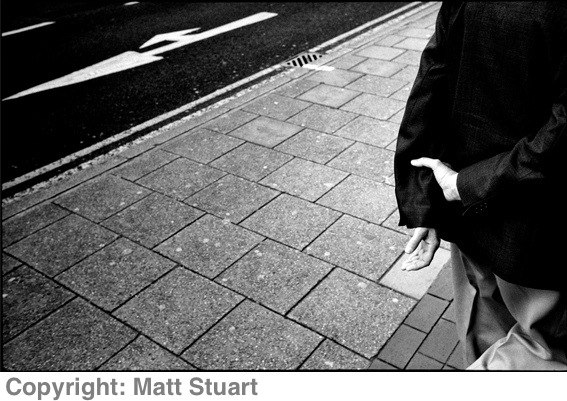
He captured what needed to be seen whether he shot this in portrait or landscape the audience would still have gained the same amount of humour from what they saw. Street photography is very spontaneous and the subject needs to be captured unaware for you to create an organic photo and even just to get away with what you shot without being called up on it. This is the same in high conflict zones as photographs can be used as a tool to change the minds of an entire nation just like in the Gulf war, the photographer needs some flexibility in angles if they want to live to show the world what they saw. The streets aren't exactly a high conflict zone as such but with modern ethics and legislations it has become a metaphorical conflict zone that i need to weave my way in and out of.
