The fusion of photojournalism and fashion gives fashion its integrity as it stops it being all about image and clothes but more about what these things represent. When Terry Jones brought I.D magazine into the forefront of socio-political issues it was deviant from the stereotypical commercial based fashion company and I like the fact it takes pride in that. Nothing will create impact if its been seen a million times before but when there is a hidden meaning to the photograph it takes actual engagement to decipher, and once that has happened the sense of achievement gained from looking underneath makes the photograph and the point it made much more memorable.
"It was very intentional to get i-D into the political," Jones says, "to shift more toward the hidden self for a deeper picture. Fashion had become too concerned with façades."
This is important to me because I don't go out day after day photographing 'unimportant' people in the hope that it will turn over a nice profit, I do it because the unimportant people hold the key to reflecting upon their status in life and what it means to be them under the rule of people that take into account statistics not individual differences. Fashion to me is a creative tool that will allow me to establish a link between an ordinary person and one that sticks out from the crowd. It will be used as a medium to transfer that ordinary persons story that takes a back seat like they do into one that stands out and is noticed just like fashionable clothing of the time.
"[British] Vogue will look at i-D and think, We'd like a bit of that photographer. Some photographers have that in mind when they shoot for us, but their work in i-D will have more soul. That's the difference. We've become a virus, which was kind of intentional. The idea was to infiltrate."
A lot of people overlook controversial matters that do not directly effect them because it is easier than dealing with the fact that their is an issue, but turning and looking at an aesthetically beautiful picture isn't hard, capturing someone in that trap forces them to subconsciously deal with the issue as it is hidden within the photograph. As Terry says "their work will have more soul" that is what it all comes down to adding a deeper meaning to the photograph by considering other concepts; poverty and controversial matters gives that photograph a soul as opposed to it just being dismissed by face value, I completely agree that in this day and age it is all about infiltrating a persons mind as we are constantly aware of being influenced and thats what I intend to do with my fashion photography.
"People are summed up by what they wear and how they look. I wanted to get under the skin of fashion."
It is all about perception and deviating from this single use of fashion photography is where Terry found his niche style that sticks to his audience like glue, people love the idea of feeling underground and beyond what is nationally accepted and thats the kind of feeling I get when I read about I.D magazine and when I look at the work within its pages. It breaks the rules whether cost effective or not, even their approach to selling is underground.
"We're lucky to break even at the end of the year. I prefer to do an advertising campaign than the magazine having to do things for the money"
The stories told by the photographs become more meaningful if the people that read and see them know that the author isn't doing it for the money but for a higher purpose, that higher purpose becomes far more believable and influential. So its not just his aesthetic style or the deeper meaning within the photograph but its the personality with which he delivers them.
This is important to me because photojournalists are often scrutinised for images they publish for being insensitive, the people see what they see interpret it and then shun it when in fact looking into the author and the perspective in which they see from may in turn communicate what was really meant to be taken from the photograph. It shows me that there are many more levels within a photo than can be generally seen, the complicity can be taken the wrong or right way and either of these cause change. If when someone feels abused by a photograph they then look to who took it for an answer usually they would find a person not so different from themselves just with a different perspective or opinion to them, but aren't we all free to have our own opinions? a photograph for me in or out of context is a captured opinion and a freedom of speech. Just because we cant understand the authors intent doesn't mean its wrong or offensive.
I talked before about there being many levels within the aesthetic and conceptual meaning of a photograph and Terry has used these levels in the forefront of I.D, creating a theoretical icon within the front page and title of his magazine.
"Freudian philosophy plays an important role in i-D mythology. According to Jones, i-D's title infers the id, as does the winking eye on every cover. Together, they represent the hidden self, our most primitive impulses organized around the instinctual urges for instant gratification."
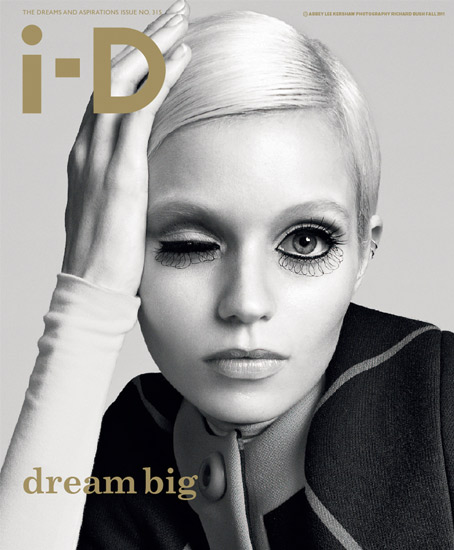
He manages to visually translate Freud's theory of the Id ego and super ego into an icon that alone aesthetically represents what the magazine is about, this is important to me because it demonstrates the power of visual language and shows the lengths and depth of which it can truly go, maybe it is just an interpretation but it could communicate a complex Freudian theory to even the illiterate. If that can be done through visual language and imagery what cant? thats how photographs change the world.
